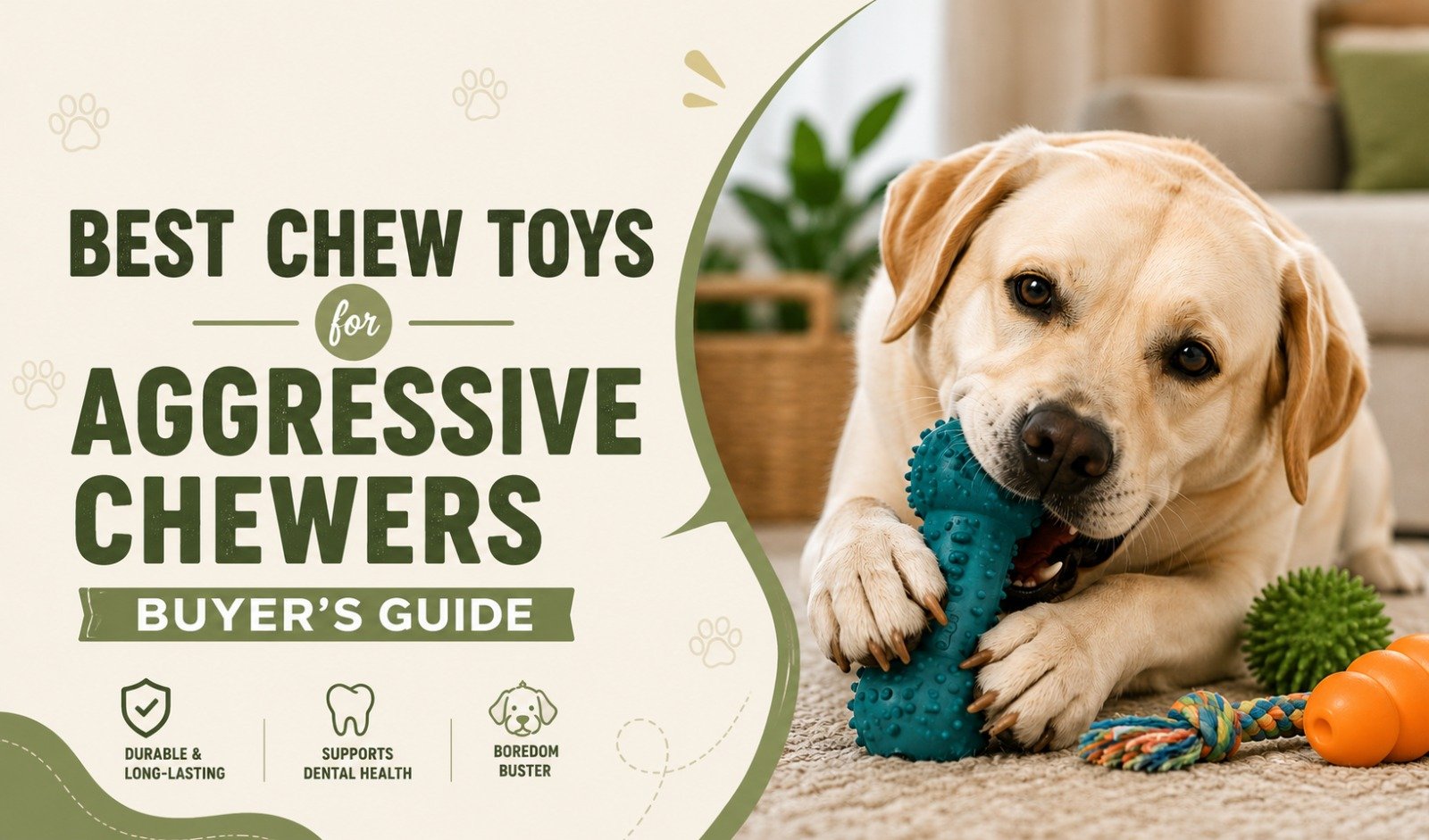
If you own a Labrador, a Rottweiler, or even a determined Indie with strong jaws, you already know the drill — a toy comes home in the morning and by evening it’s in pieces on the living room floor. Power chewers aren’t being naughty; they’re doing exactly what dogs are built to do. The problem is that most toys sold in India simply aren’t built for that level of force.
This guide breaks down what actually makes a chew toy “aggressive chewer” rated, how to pick the right one for your dog’s size and chewing style, and which options are worth adding to your cart — without turning it into a monthly replacement expense.
Why “Aggressive Chewer” Toys Are Different
Not all chew toys are engineered the same way, even when they look similar on a shelf. The difference comes down to three things: material, density, and construction.
- Material grade: A standard rubber squeaky toy and a chew toy for aggressive chewers might both say “rubber” on the pack, but the density and thickness used for power chewers is significantly higher, so it resists puncturing and tearing instead of shredding on contact.
- Single-piece moulding: Toys built for tough chewers are usually molded as one solid piece rather than glued or stitched together, removing the seams that are usually the first thing to give way.
- Textured surfaces: Ridges, nubs, and grooves aren’t just for looks — they give your dog’s teeth something to grip and gnaw on, which redirects chewing energy away from the toy’s structure and toward the surface texture, extending its life.
This is why a toy specifically labelled for aggressive or power chewers, tends to survive weeks or months longer than a generic chew toy bought for the same dog.
How to Choose the Right Chew Toy for a Power Chewer
Picking the right toy isn’t about buying the toughest-looking one on the shelf. It’s about matching the toy to your dog’s size, bite force, and chewing habits.
Rubber vs TPR vs Nylon
Material | Best For | Durability | Dental Benefit |
Natural rubber | Moderate to heavy chewers | High — flexes instead of splintering | Good — gentle on gums, satisfying bounce |
TPR (thermoplastic rubber) | Medium to heavy chewers | High — resists tearing, often combined with rope or jute | Good — textured grip cleans teeth as dog gnaws |
Nylon | Light to moderate chewers only | Very high, but hardness can be risky for teeth | Moderate — can be too hard for some dogs |
For genuinely aggressive chewers, natural rubber and TPR blends are usually the safer long-term bet. Nylon chews can outlast almost anything, but very hard nylon carries a higher risk of chipping teeth if your dog bites down at full force — something worth knowing before you buy, not after a vet visit.
Matching Toy to Dog Size and Bite Force
A toy sized for a Beagle won’t survive five minutes with a Rottweiler, and a toy sized for a Rottweiler can be a choking risk for a smaller dog. As a rule of thumb:
- Small breeds (up to 10 kg) — look for compact, dense rubber toys rather than scaled-down versions of large-breed toys.
- Medium breeds (10–25 kg) — TPR and jute-rope combinations, hold up well to regular chewing and tugging.
- Large and giant breeds (25 kg+) — go for the thickest rubber or TPU options available and check reviews specifically mentioning “aggressive chewer” or “power chewer” before buying.
A simple check vets recommend: if you can dent the toy’s surface with your fingernail, it’s soft enough not to risk your dog’s teeth; if your nail can’t leave a mark, it may be too hard for daily chewing, no matter how “indestructible” it’s marketed as.
Best Chew Toy Types for Aggressive Chewers
Here’s how the main categories stack up, with specific picks available on CadoWorld.
Toy Type | Good For | Price Range (India) | Example |
Solid rubber chew bones | Heavy chewers, teething puppies | Rs. 165 – Rs. 300 | |
TPU rugby / activity balls | Fetch + chew combo, high-energy dogs | Rs. 800 – Rs. 950 | |
Rope + TPR hybrids | Dogs who tug as much as they chew | Rs. 250 – Rs. 350 | |
Ring and bolt-style chews | Dogs that like gripping and shaking toys | Rs. 250 – Rs. 300 | |
Textured barrel / hole toys | Mental stimulation + treat stuffing | Rs. 1,300 – Rs. 1,450 | |
Squeaky reinforced bones | Chewers who also love sound/play | Rs. 450 – Rs. 550 |
If your dog tends to destroy 2-3 toys a month, buying a couple of different types from this list and rotating them tends to work better than repeatedly replacing the exact same toy — dogs often lose interest in a toy they’ve “solved,” and a different texture or shape resets that curiosity.
Safety Tips When Giving Chew Toys to Power Chewers
Even the toughest toy isn’t a substitute for keeping an eye on your dog, especially in the first few sessions with anything new.
- Supervise the first few uses. This is when you’ll find out how your dog actually chews — whether they gnaw steadily or try to tear pieces off.
- Inspect toys weekly for damage. Small tears, exposed inner material, or missing chunks mean it’s time to retire the toy, not push it further.
- Size up, not down, when in doubt. A toy that’s slightly too large is safer than one small enough to be swallowed whole.
- Rotate 2-3 toys weekly rather than leaving one out permanently — this reduces the constant force any single toy takes and keeps your dog more engaged.
Caring for and Extending the Life of Any Chew Toy
- Wash rubber and TPR toys in warm soapy water weekly, or run dishwasher-safe ones through a cycle without detergent.
- Freeze rubber toys (like a stuffed rubber bone) for a few hours before giving them to your dog — this slows down chewing and makes the toy last longer per session, which is especially useful in Indian summers when dogs chew more out of restlessness indoors.
- Store toys out of direct sun between uses. Extended heat exposure can make rubber brittle over time, which shortens its lifespan faster than chewing does.
- Keep a rotation of at least three toys so no single one is under constant daily stress.
Ready to Stop Replacing Toys Every Week?
Browse CadoWorld’s full range — from solid rubber bones to TPU activity toys — and find something that can actually keep up with your dog
Frequently Asked Questions
If your dog can destroy a standard soft toy within a single sitting, tears through fabric or stuffing quickly, or has already broken through a few “durable” toys, they likely need toys specifically labeled for aggressive or power chewers rather than general-purpose ones.
Yes, good-quality natural rubber and TPR toys are safe for daily chewing as long as they pass a basic flex and dent test and you replace them once they show cracks, tears, or missing pieces.
There’s no fixed timeline — it depends on how hard your dog chews. As a habit, check toys weekly and replace anything with cracks, holes, or a shape that no longer resembles the original.
Toys made for aggressive adult chewers are often too hard for a teething puppy’s developing jaw and teeth. Puppies generally do better with softer teething-specific rubber toys, moving up to power-chewer toys once their adult teeth are fully in.